
Meat Cleaver Sizes Explained: Which Blade Length to Buy
October 13, 2026 · By Matt
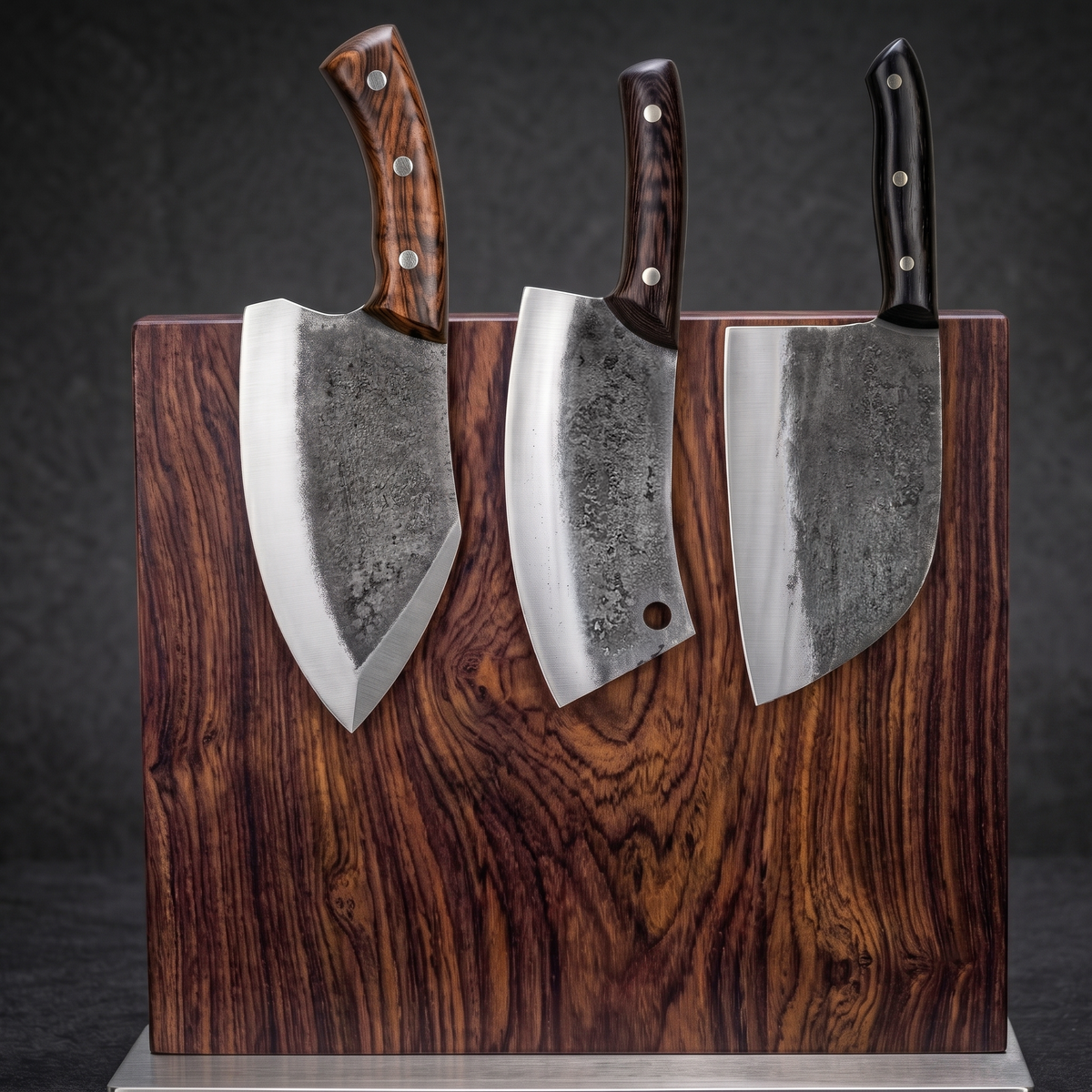
For most kitchens the right meat cleaver size is an 8 inch blade in the middle of the weight range, something like our 380 g Kraken or 581 g Kodiak, because that length covers a whole chicken and a rack of ribs and still does the vegetables. Drop to the 5.5 to 6 inch class if you mainly portion poultry, and go up to 8.7 inches and over a kilo only if you split pork shoulders and large bones often.
Cleaver sizing gets argued about as if it were a matter of taste. Mostly it is not. Blade length, blade height, spine thickness and weight each do a specific job, and once you know the jobs the choice narrows quickly. This guide works through all four, groups our cleavers by size class, matches each class to its work, and ends with the one we would hand you if you insisted on buying a single cleaver.
What Does Each Cleaver Measurement Actually Do?
Blade length
Length is the number everyone shops by, and it is the least important of the four. It decides how much edge lands on the board in one stroke and how far you can reach across a big board. It does not decide how well the cleaver cuts bone. A 6 inch cleaver and a 9 inch cleaver of the same weight land with the same force. The long one spreads it over more edge.
Blade height
Height, from edge to spine, gives a cleaver its square look and its second career as a scoop. A tall blade sweeps chopped onion off the board with the flat, keeps your knuckles clear on a straight down chop, and carries more steel above the edge, which is where the weight lives.
Spine thickness
The spine is the back of the blade, and its thickness tells you what the cleaver was built to hit. Our Kermode runs 0.1 inch at the spine and rocks through vegetables. The Rhino runs 0.3 inch, three times as thick, and goes through a pork knuckle without being asked twice. A thick spine backs up the edge on bone. A thin spine falls through soft food with less wedging. Neither is better, they are for different afternoons.
Weight
Weight is the number to look at first. It is what splits a joint, and what your wrist complains about afterward. Our range runs from the 270 g Mastodon to the Mammoth at about 1500 g, and two cleavers with the same blade length can sit at opposite ends of it. Buy by weight and let the length follow.
Does a Longer Cleaver Cut Bone Better?
No. A heavier one does. A cleaver does not saw through bone, it lands on it, and the energy in that landing comes from how much steel is moving and how fast. Extra length only helps if it brings extra weight along. This is why the 6.6 inch Megalodon at 430 g out chops the 7.5 inch Mastodon at 270 g on chicken bones every time, and why the 8 inch Rhino at 1250 g behaves more like the 8.7 inch Grizzly than like the other 8 inch cleavers on our shelf. The same point is made in the Wikipedia entry on the cleaver, which credits the chopping momentum partly to the swing and partly to how heavy the cleaver is.
The flip side is that weight costs you control. A 1250 g cleaver is wonderful on a shoulder and tiresome on scallions, so if bone is an occasional visitor rather than a resident, a middle weight does both jobs well enough.
Meat Cleaver Size Chart
Every cleaver we make, smallest to largest, lengths in inches and weight in grams. Where the product page does not list a spine thickness, the table says so rather than guessing.
| Cleaver | Blade | Overall | Handle | Spine | Weight |
|---|---|---|---|---|---|
| 5.5" clip point cleaver | 5.5" | 10" | 4.5" | not listed | 270 g |
| Warthog 6" | 6" | 10.5" | 4.5" | 0.2" | 308 g |
| Razorback 6" | 6" | 10.8" | 4.8" | not listed | 272 g |
| Aurochs 6" | 6" | 10.9" | 4.9" | 0.1" | 404 g |
| Megalodon 6.6" | 6.6" | 12" | 4.9" | 0.2" (5 mm) | 430 g |
| Kermode 7" chef cleaver | 7" | 11.4" | 4.9" | 0.1" (2.5 mm) | 349 g |
| Mastodon 7.5" | 7.5" | 12" | 4.5" | 0.1" | 270 g |
| 7.5" butcher cleaver | 7.5" | 13.4" | 5.9" | not listed | 700 g |
| Kraken 8" | 8" | 12.2" | 4.7" | not listed | 380 g |
| Kodiak 8" | 8" | 13.8" | 5.9" | not listed | 581 g |
| Rhino 8" | 8" | 12.7" | 5.9" | 0.3" (7.6 mm) | 1250 g |
| Grizzly 8.7" | 8.7" | 13.6" | 4.9" | not listed | 1073 g |
| Mammoth 9.1" | 9.1" | 14" | 4.9" | not listed | about 1500 g |
Two things stand out. Weight does not follow length, the Aurochs at 6 inches weighs more than the Kraken at 8. And handle length barely moves, 4.5 to 5.9 inches across the whole list, so the grip feels familiar as you move up.
The 5.5 to 6 Inch Class
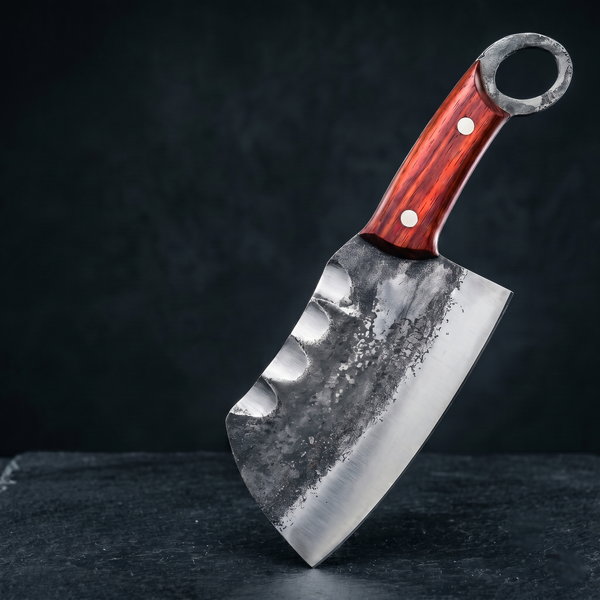
Four cleavers, 270 g to 404 g, 10 to 10.9 inches overall. They fit a normal board with room to spare. The Razorback 6" and the 5.5" clip point cleaver both carry a finger hole for a pinch grip and a hook. The Razorback adds a saw tooth spine, the clip point a spine notch. The Warthog 6" is the compact bruiser at 0.2 inch on the spine and 308 g, and gets through chicken joints better than its size suggests. The Aurochs 6" is the odd one out, a spear point cleaver at 404 g, heavier than some of the 7 and 8 inch blades on the chart.
Pick this class if you mostly break down poultry, cook at camp, or have a small kitchen where a 14 inch knife is a hazard.
The 6.6 to 7.5 Inch Class
The middle of the range and the most varied part of it. The Megalodon 6.6" is what most people picture when they say meat cleaver: a 0.2 inch spine, 430 g, a finger hole and no interest in subtlety. The 7.5" hand forged butcher cleaver is heavier again at 700 g with a 5.9 inch handle, and on weight alone it borders the heavy class. The Mastodon 7.5" goes the other way: 0.1 inch spine, 270 g, a clip point and a hammer textured flat. It is a cleaver shaped slicer, lovely on boneless meat and a poor choice for bone.
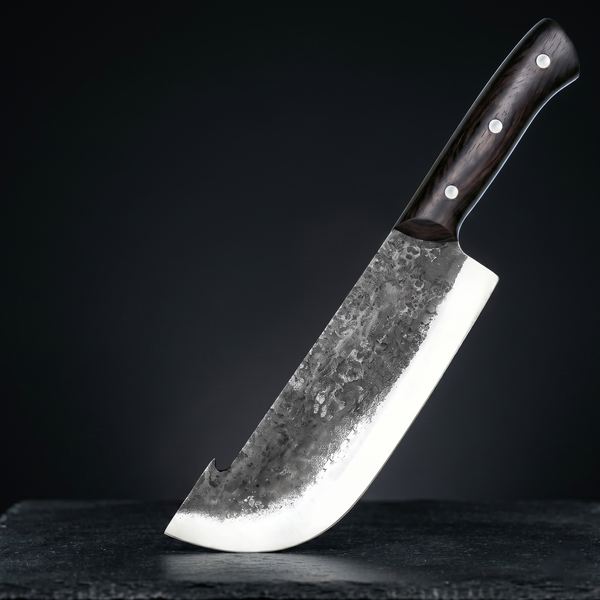
The Kermode 7" chef cleaver belongs here as the cousin rather than the sibling. It is a Serbian chef knife, a tall chef cleaver with a curved edge that rocks, 349 g on a 2.5 mm spine, and the one to pick if you want all the vegetable and boneless meat work done by something that looks like a cleaver. Our cleaver vs chef knife guide covers where that line sits.
Pick this class for ribs, chicken and the normal run of weekend cooking. Mastodon or Kermode if bone is rare in your kitchen, Megalodon or the butcher cleaver if it is not.
The 8 Inch All Rounders
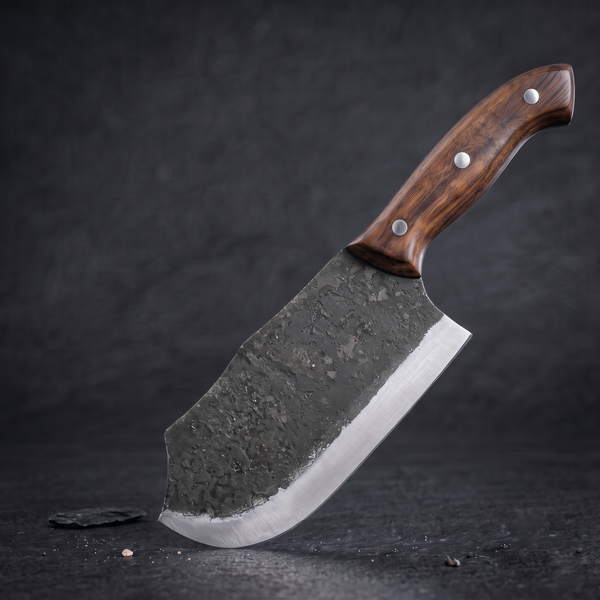
Three 8 inch cleavers, three very different knives. The Kraken 8" is the light one at 380 g and 12.2 inches overall, hammer textured, with a black wenge handle. It handles like a big chef knife and chops like a cleaver, which is the whole point. The Kodiak 8" butcher cleaver is the drop point at 581 g and 13.8 inches overall, with a 5.9 inch rosewood handle, enough weight for ribs and a curved belly that slices. The Rhino 8" is the heavyweight: 0.3 inch at the spine, 1250 g, 12.7 inches overall on a 5.9 inch walnut handle. It is made to order, takes 2 to 3 weeks before it ships, and belongs with the heavy class on everything except blade length.
If you came here to find one cleaver for a normal kitchen, you are choosing between the Kraken and the Kodiak. The Kraken for vegetables and boneless cuts most nights, the Kodiak for more authority on bone at the cost of roughly 200 g.
The 8.7 to 9.1 Inch Heavy Class
The Grizzly 8.7" weighs 1073 g on a 13.6 inch overall length. The Mammoth 9.1" is about 1500 g and 14 inches overall, with a thick spine built for one purpose. Both carry 4.9 inch olive wood handles, no longer than on a 6 inch cleaver, so all the extra steel is in the blade. These are not kitchen knives that can chop bone. They are bone choppers that can, if you insist, cook dinner.
Buy here if you break down whole animals or large primal cuts, split pork shoulders with the blade bone in, process game, or run a smoker that goes through a hog regularly. Do not buy here for a first cleaver unless you know that is your life. A blade of about 1500 g on a bunch of herbs is comedy, and the floor will not find it funny.
Which Cleaver Size for Which Job?
Chicken and poultry: anything from the 6 inch class upward, since chicken bones give way to a sharp cleaver around 300 g. The Warthog and the Megalodon are the natural picks.
Ribs: some weight behind the edge, 430 g and up, so you split between the bones in one stroke. The Kodiak and the 7.5" butcher cleaver are in the right zone.
Pork shoulder and large joints: Rhino and Grizzly territory. You want weight and a thick spine so the blade does not stall halfway.
Whole animals and game: the Mammoth, with a boning knife for the fiddly work. Our guide to what a meat cleaver is used for covers which parts of a carcass want the cleaver and which want a thinner blade.
Vegetables: the lighter and thinner the better. The Mastodon, the Kraken and the Kermode fall through squash and cabbage.
Camp cooking: short and light. The 5.5" clip point cleaver at 10 inches overall and 270 g packs flat and hangs off a nail by its finger hole.
Board Size and Storage
A cleaver is only as useful as the board under it, so measure the board before you buy the knife. It wants to be a few inches longer than the cleaver, or the tip finds the counter. A 10 inch cleaver is happy on almost anything. A 14 inch one wants a big board, and a heavy one wants a thick board that does not bounce. End grain wood or thick plastic takes the landing kindly. Glass and stone chip the edge and should be given to someone you dislike.
Storage follows weight too. A magnetic strip holds a 300 g cleaver and will eventually drop a 1250 g one on your toes. Heavy cleavers want a block, a drawer slot with a blade guard, or a hook through the finger hole where there is one. Whatever you choose, put it away dry with a light coat of food safe oil. High carbon steel does not forgive a damp drawer.
If You Only Buy One Cleaver
Buy the Kodiak 8". It has enough weight at 581 g to split ribs cleanly, a drop point that slices and an 8 inch blade that fits a normal board. If you cook more vegetables than meat, take the Kraken 8" instead, roughly 200 g lighter. If you cook more bone than anything else, order the Rhino 8" and skip the middle entirely. If deciding is not your strong suit, the Butcher's Trio covers three sizes at once.
In stock cleavers reach you in 5 to 6 business days across the USA and Australia, and every one is hand forged high carbon steel, full tang, with a lifetime warranty against defects in materials and craftsmanship. For a ranking rather than a sizing lesson, our best meat cleaver guide picks a favorite in each class, and the full range, from the 5.5 inch clip point up to the Mammoth, is in our hand forged cleavers collection.
Questions
What size meat cleaver should I buy for home use?
An 8 inch cleaver in the middle of the weight range suits most home kitchens. Our Kraken at 380 g and Kodiak at 581 g both fit a normal cutting board, split chicken bones and ribs cleanly, and still handle vegetables without tiring your wrist. Go smaller only if you mostly portion poultry, and heavier only if you break down large joints often.
Is a 6 inch or 8 inch cleaver better?
Neither is better, they do different work. A 6 inch cleaver such as the Warthog or Razorback is lighter, fits a small board and suits chicken, duck and camp cooking. An 8 inch cleaver like the Kodiak gives you more reach and usually more weight for ribs and bigger cuts. If you only own one, the 8 inch class covers more jobs.
How heavy should a meat cleaver be for cutting bone?
Chicken bones give way to a sharp cleaver around 300 g. Ribs want something from about 430 g upward so you split between the bones in one stroke. Pork shoulders, large joints and whole animals call for a kilo or more, which is where the Rhino at 1250 g, the Grizzly at 1073 g and the Mammoth at about 1500 g come in.
Does cleaver weight matter more than blade length?
Yes, for bone it does. A cleaver chops with momentum, and momentum comes from how much steel is moving and how hard you swing it, not from how long the edge is. A 6.6 inch Megalodon at 430 g out chops a 7.5 inch Mastodon at 270 g on bone. Length mainly matters for reach and for long cuts through vegetables.
Will a 9 inch cleaver fit on a normal cutting board?
Often not comfortably. The Mammoth 9.1 inch cleaver is 14 inches overall, so on a board shorter than that the handle hangs off the edge and the tip hits the counter. Measure your board first and allow a few inches more than the cleaver's overall length. A thick end grain or plastic board also helps, because heavy cleavers make light boards bounce.
Shop the knives from this guide
Keep reading
How to Pick the Best Meat Cleaver for Your Kitchen
A buyer's guide to the best meat cleaver for your kitchen. What weight, blade length, height, spine, handle, finger hole and steel actually change,...
Serbian Cleaver vs Chinese Cleaver: Which One Does Your Kitchen Need?
The Serbian cleaver is thick, heavy and curved, built to rock through vegetables and land hard on meat and joints. The Chinese cleaver is...
What Is a Meat Cleaver Used For? 9 Jobs It Does Better Than Your Chef Knife
What is a cleaver knife used for? Nine kitchen jobs a meat cleaver does better than your chef knife, from spatchcocking chicken and portioning...