
What Is a Brisket Knife, and Do You Actually Need One?
October 13, 2026 · By Matt
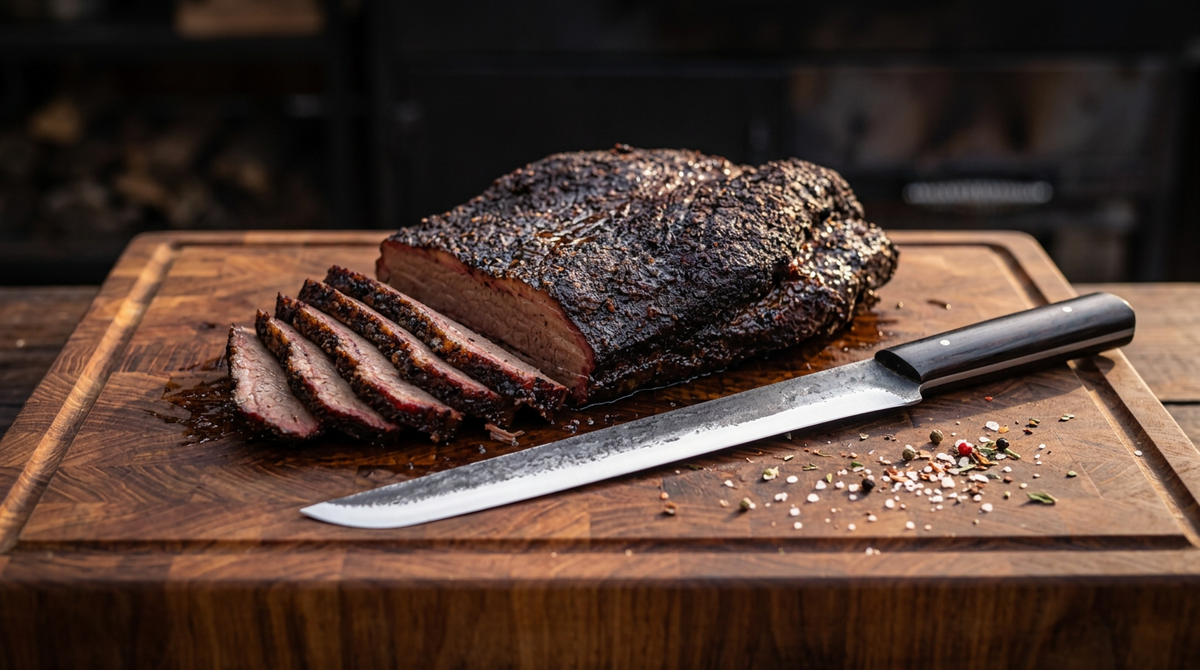
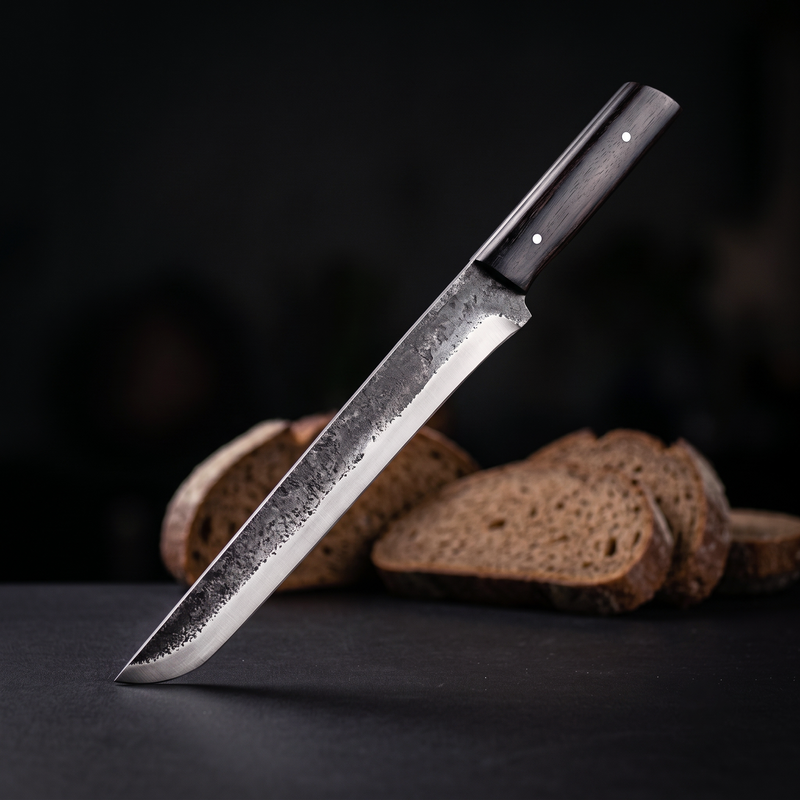
A brisket knife is a long, narrow slicing knife, usually 10 to 14 inches, with a straight edge, built to cut across a cooked brisket in one smooth pull instead of a dozen short saws. Our Mamba 11" brisket slicing knife is one: an 11 inch blade, 16.3 inches overall, 264 grams, with the forge scale left on the flats. Whether you need one depends on how much brisket you cook and how much you care what the slices look like.
Plenty of people smoke a brisket for twelve hours, rest it for two, then carve it with the same 8 inch chef knife they use on onions. The brisket survives. The slices, less so. This guide explains what a brisket knife is, why the length matters, the edge and tip choices, how to slice against the grain when the grain keeps changing its mind, and what else belongs in the kit. If you only want to know which slicer to buy, our ranking of the best knife for slicing brisket does that job. This one answers the question before it.
What Is a Brisket Knife?
It is a slicer, nothing more exotic. The blade is long and fairly narrow from spine to edge, the edge runs close to straight for most of its length, and the steel behind it is kept thin so it slides through meat instead of wedging it apart. You will see it sold as a brisket knife, a brisket carving knife, a brisket cutting knife or simply a slicing knife. Same tool, different label on the box.
What makes it a brisket knife rather than a general carving knife is mostly length. A carving knife for a roast chicken can get away with 8 or 9 inches. Brisket is wider, and the whole point of the long blade is to reach across it. The 12 inch brisket knife is the size most people picture, and anything from about 10 to 14 inches sits in the same family.
The Mamba fits that description: an 11 inch blade with a long straight edge, a 5.2 inch handle, hand forged from high carbon steel, full tang with steel pins.
Why Does Length Matter So Much?
Because the cleanest slice is a single pull. You set the heel of the blade on the far side of the meat, draw the knife toward you along its full length, and let the edge do the work with almost no downward pressure. On a whole packer the flat is often wider than an 8 inch chef knife is long, so the short knife runs out of blade halfway across. Then you push it back, pull again, push again. Every change of direction tears the surface a little.
That tearing matters more on brisket than on most cuts. A well cooked brisket is soft, and the bark on the outside is crisp. Saw back and forth and the bark cracks off in pieces while the meat underneath starts to shred, which is fine if you wanted pulled beef and less fine if you wanted slices. Brisket starts out tough because of the collagen fibers in its connective tissue, and long, slow cooking is what softens it: Wikipedia's entry on brisket.
Granton Edge or Plain Edge, Rounded Tip or Pointed?
Granton or plain
A granton edge has a row of shallow scallops ground into the flat of the blade just above the edge. The hollows let a little air in between steel and meat, so slices fall away rather than cling. On sticky meat it can help. A plain edge is simpler to sharpen, with nothing to work around on the stone. Neither will save a brisket cut with the grain.
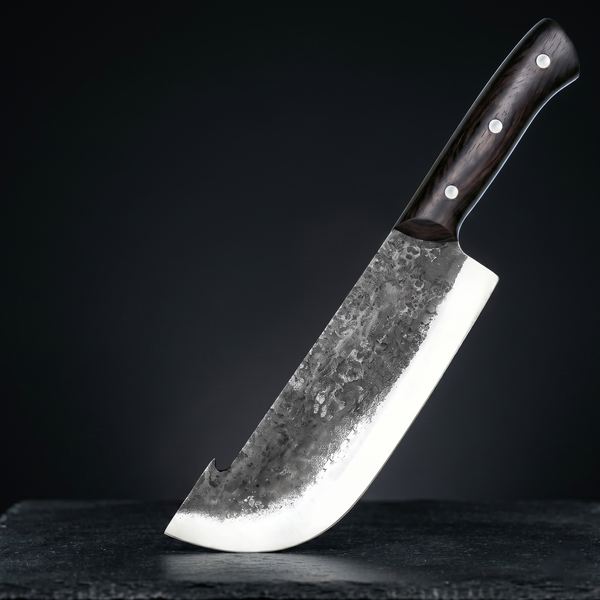
On our knives the forge scale left on the flats does part of that job. It is not polished smooth, and the rougher surface helps meat come off the blade. It is not a granton edge and we will not pretend it is.
Rounded or pointed tip
Many dedicated brisket slicers have a rounded tip. A rounded tip has nothing to snag on the board or catch in the meat, and when a slicer spends its whole life cutting straight across a big piece of meat it rarely needs to stab anything. A pointed tip is more versatile. It can start a cut, follow the seam between the point and the flat, and work around a bone in a ham or a turkey. If the knife is only for brisket and prime rib, round is fine. If it has to earn its keep on other cuts, a point is more useful.
How Do You Slice Brisket Against the Grain?
Meat is made of long bundles of fibre running in one direction. Cut along them and every slice is a mouthful of long, chewy strands. Cut across them and each bite is a stack of short fibres that come apart easily. That is all "against the grain" means, and it is the single biggest factor in whether brisket slices feel tender.
The catch is that a brisket is two muscles, and their grains do not run the same way. The flat is the long, lean muscle underneath. The point is the fattier, thicker muscle sitting on top of one end of it. Their fibres run at an angle to each other, so a cut that goes neatly across the flat ends up going roughly along the point.
The fix is simple:
- Before the cook, while the brisket is raw, look at the flat and note which way the fibres run. Some people trim a small corner off across the grain so they can find it again under the bark.
- After the rest, slice the flat across its grain, starting from the thin end, in slices about the thickness of a pencil.
- When you reach the point, separate it from the flat along the seam of fat between them.
- Turn the point so you are cutting across its own grain, and slice it a little thicker, or cube it for burnt ends.
Step three is where a pointed tip earns its place, though a sharp boning knife does that cut just as well. The long slicer does everything else.
Can a Chef Knife Slice a Brisket?
Yes, on small cuts. A trimmed flat from the supermarket, a couple of pounds of corned beef, a half brisket in the oven: a good chef knife like our Ironclad 8.7" handles those without fuss, as long as it is sharp and you take your time.
On a whole packer it does the job badly. The blade is too short to reach across the flat in one pull, so you saw. The blade is also tall and the edge is curved for rocking through vegetables, so as you draw it toward you the curve keeps lifting the edge off the meat and the tall flat drags along the slice. You end up with uneven slices and a pile of loose bark. It still tastes like brisket. It just looks like you lost an argument with it.
A cleaver is worse. It is built to come down hard, the opposite of what tender meat wants. Our guide to the best knives for cutting meat covers which blade suits which job in more detail.
What Else Does a Brisket Kit Need?
The slicer comes out at the end. Most of the knife work on a brisket happens before the fire is lit.
A boning knife for trimming
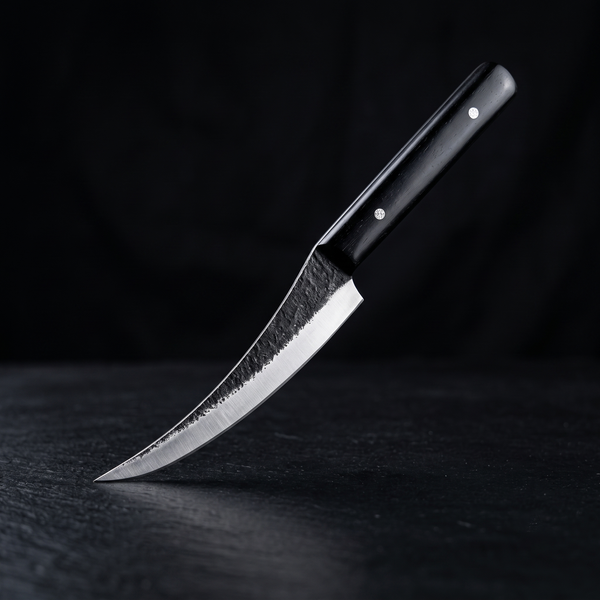
Trimming a packer means taking the fat cap down, cutting out the hard fat in the seam, pulling off silverskin and squaring the thin edges. That is boning knife work. The Mako 7.5" boning knife has a narrow trailing point blade and weighs 200 grams, so you can hold it nearly flat under the fat for a long time and see what the edge is doing. Our guide on what a boning knife is used for covers the technique. For the fiddly corners, the Hellfang 5" butcher knife is a small meat trimming knife that gives you control right at the tip.
A cleaver for anything with a bone in it
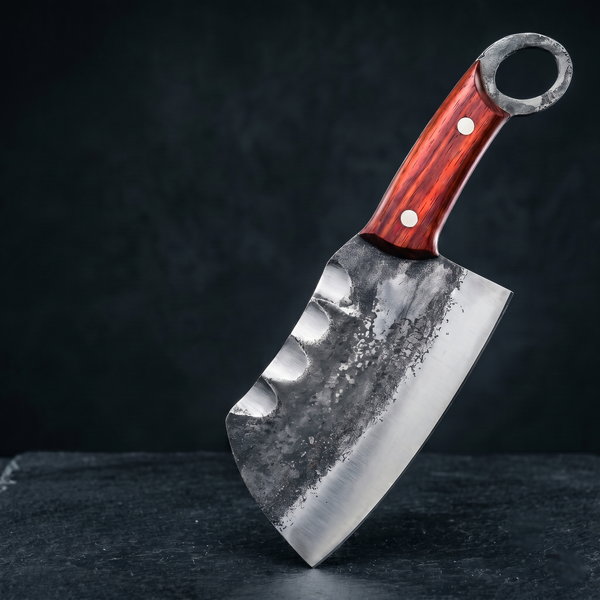
Brisket has no bone. Beef ribs do, and they tend to share the smoker. A slicer's fine edge will chip on bone. That is cleaver work. The Kodiak 8" butcher cleaver, at 581 grams with a drop point and a rosewood handle, portions raw short rib plates and splits a rack into servings. The Kraken 8" is lighter at 380 grams, hammer textured, with a black wenge handle, and suits people who want a cleaver that still feels quick. For the heavy end, the Rhino 8" Serbian cleaver weighs 1250 grams with a 0.3 inch thick blade and is made to order, so allow 2 to 3 weeks before it ships. One rule applies to all of them: never chop frozen bone or frozen meat with a cleaver, because it chips the edge.
If you would rather buy the bone side of the kit in one go, the Butcher's Trio gives you a 7.5" butcher cleaver, an 8" drop point cleaver and a 7" sheep foot cleaver. The full range is in our hand forged cleavers, and the slicer and trimming knives sit together in the BBQ knives collection.
The Brisket Knife Kit Compared
| Knife | Blade length | Job in the brisket process |
|---|---|---|
| Mako boning knife | 7.5" | Trimming the fat cap, the seam fat and silverskin before the cook |
| Hellfang butcher knife | 5" | Close trimming on the edges and the thin flap |
| Mamba slicing knife | 11" | Slicing the cooked flat and point in one pull per slice |
| Ironclad chef knife | 8.7" | Small cuts and half briskets, plus everything else in the kitchen |
| Kodiak butcher cleaver | 8" | Bone in cuts on the same cook, such as beef ribs |
| Kraken cleaver | 8" | Lighter bone and portioning work |
| Rhino Serbian cleaver | 8" | Heavy bone work, made to order |
So, Do You Need a Brisket Knife?
If you cook a whole packer more than once or twice a year, yes. It is the cheapest upgrade in the whole process. You already paid for the meat, the wood and a night of checking the smoker, and a long slicer is what turns all that into slices that look like the effort went somewhere.
If you cook a small flat now and then, a sharp chef knife is enough, and you can skip it without guilt. The same goes if your brisket mostly ends up chopped for sandwiches. A chopped brisket does not care how it was cut. The slicer also earns its drawer space on prime rib and a whole turkey breast.
Looking After a Slicer After Greasy Work
Brisket fat is the hard part of the cleanup. It sets on cold steel as a waxy film, and high carbon steel left under a coat of fat and meat juice will start to spot. So do not leave the knife on the board while everyone eats.
Wipe off most of the fat with a paper towel, then hand wash in hot, soapy water. Dry it at once, spine and handle joint included, and wipe on a light coat of food safe oil. No dishwasher and no soaking in the sink, which is where a long knife gets forgotten under the plates.
The blade will darken over time, and that patina is normal on high carbon steel. Hone lightly before each brisket, and when honing stops bringing the edge back, go to a whetstone. Keep it out of a loose drawer, where an 11 inch edge meets everything else you own. The lifetime warranty covers defects in materials and craftsmanship. It does not cover the drawer.
Once you know you want a slicer, our guide to the best knife for slicing brisket compares the options side by side. And for the beef ribs that keep turning up next to the brisket, start with our meat cleavers.
Questions
What size brisket knife should I buy?
Most brisket knives run from about 10 to 14 inches, and 12 inches is the size people picture. The goal is a blade long enough to cross the flat of a whole packer in one pull. Our Mamba has an 11 inch blade, which reaches across most briskets without feeling awkward on a home cutting board.
Do you really need a brisket knife?
If you cook a whole packer brisket more than once or twice a year, a long slicer is worth having, because it cuts each slice in one pull and keeps the bark on. For a small flat now and then, or brisket that gets chopped for sandwiches, a sharp chef knife does the job well enough.
Is a granton edge better for slicing brisket?
A granton edge has shallow scallops above the edge that can help slices fall away from the blade. It helps a little on sticky meat. A plain edge is simpler to sharpen. Technique matters far more: rest the brisket, slice against the grain, and use one long pull per slice rather than sawing back and forth.
Can I use a brisket knife to trim the fat before smoking?
You can, but it is the wrong shape for it. A long slicer is hard to steer under a thin sheet of fat and into the seam between the point and the flat. A narrow boning knife like the Mako 7.5 inch does trimming better, and the slicer stays sharp for the job it was made for after the cook.
Which way do I slice the point and the flat?
Slice each muscle across its own grain. The fibres in the flat and the point run at an angle to each other, so slice the flat first, separate the point along the seam of fat between them, then turn the point and cut across its grain. Many people slice the point a little thicker or cube it for burnt ends.
Shop the knives from this guide
Keep reading
Best Knife for Slicing Brisket: Length, Edge and Timing
What makes the best knife for slicing brisket: a long straight edge, enough length to cross a packer flat, and a sharp blade that...
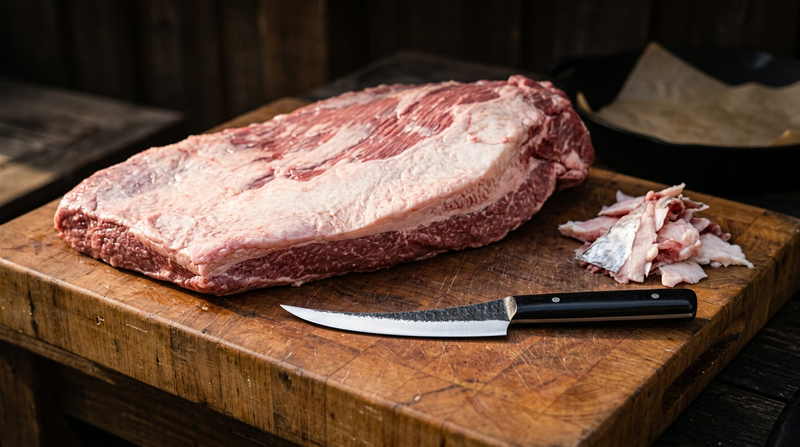
Best Knife for Trimming Brisket: Boning Knife or Butcher Knife?
A narrow boning knife is the best knife for trimming brisket. It takes the fat cap down to about a quarter inch and follows...
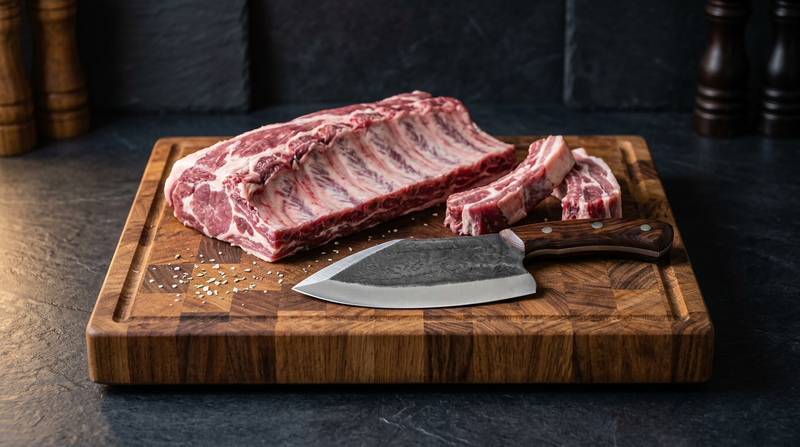
Best Knives for Cutting Meat: Which Blade for Which Cut
The best knife for cutting meat depends on the cut in front of you. Bone wants a heavy cleaver, trimming wants a small butcher...