
Knife Blade Shapes Explained: Drop Point, Clip Point and More
October 13, 2026 · By Matt
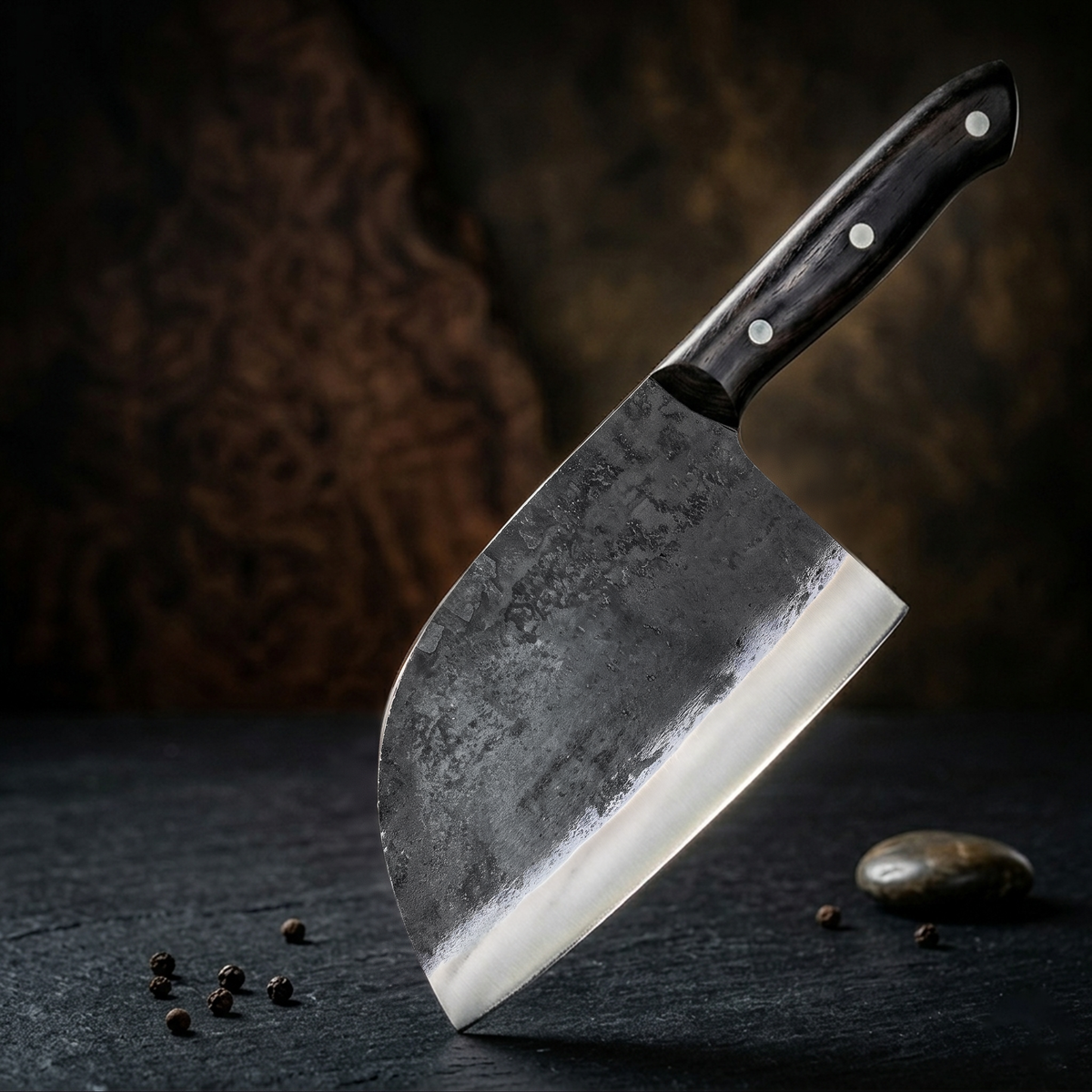
Knife blade shapes are the outline of the blade seen from the side: where the tip sits, what the spine does on its way there, and how the edge runs between heel and point. A drop point lowers the tip for a sturdy, controllable point. A clip point cuts the spine back for a finer tip. A spear point centres the tip, a sheep foot removes it almost entirely, a trailing point lifts it, and a cleaver gives up on a tip and goes tall and square instead.
Most people buy a knife by length and then wonder why their 8" behaves nothing like the 8" their neighbour swears by. The length was the same. The shape was not. This guide walks through the shapes you will meet in a kitchen or at a butcher block, each with a hand forged high carbon steel knife of ours that carries it, then the features people ask about that are not shapes at all. The chart is near the bottom.
What Counts as a Blade Shape, and What Does Not?
Blade shape, or profile, is the silhouette. Three lines make it: the spine running from handle to tip, the edge running from heel to tip, and the tip where the two meet, or fail to meet in the case of a cleaver. Change any one and you have a different shape.
What is not a shape: steel thickness, the edge grind, the handle, the finish on the flats, and the weight. Those matter, but they are separate choices. Our Rhino 8" Serbian cleaver and our Kraken 8" cleaver both have an 8" blade and both sit in the tall cleaver family, yet the Rhino is 0.3" thick and weighs 1250 g while the Kraken weighs 380 g. Same length, close cousins in shape, very different afternoon.
Does Blade Shape Matter More Than Blade Length?
Yes, for how the knife behaves. Length decides how much you cut in one stroke. Shape decides what kind of stroke you get. A straight edge chops and push cuts. A curved edge rocks and slices. A fine tip gets into joints and under silverskin. A square front with no tip lets you put your whole weight over the edge. A 6" blade with the wrong shape will frustrate you more than a 9" with the right one. Length still matters, which is why a tall 9" cleaver and a tall 6" cleaver are not the same tool. That side is in our meat cleaver sizes explained guide.
Pointed Shapes: Drop Point, Clip Point and Spear Point
Drop point
On a drop point, the spine runs straight from the handle and then curves gently down to meet the edge below the spine line. The tip ends up low and backed by plenty of steel, so it is sturdy and easy to steer, and the edge keeps a modest belly so the knife slices as well as it chops. Our Kodiak 8" butcher cleaver is a drop point in the Serbian style: tall through the body, a 5.9" rosewood handle, 581 g on the scale, and a tip that finds the gap between two ribs without you aiming like a surgeon. The 8" drop point cleaver in our Butcher's Trio is the same shape.
Clip point
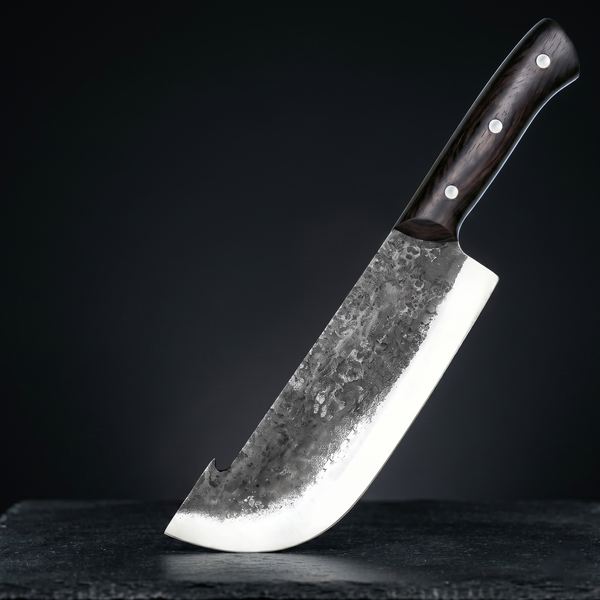
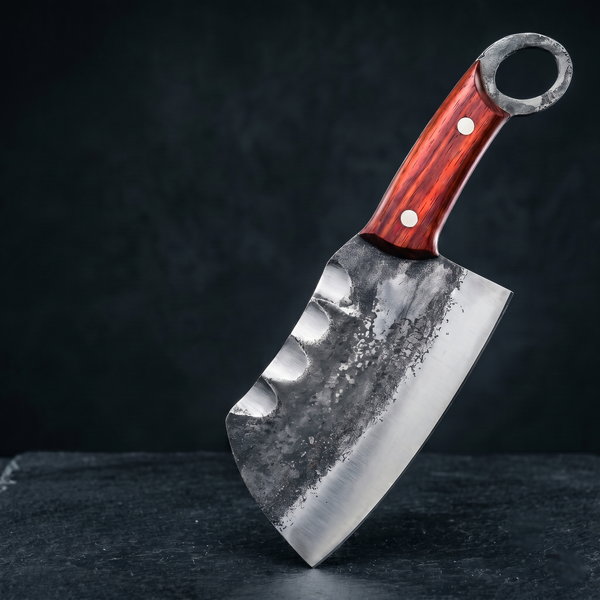
A clip point looks as though someone clipped a section off the spine near the front, leaving a finer, more upswept tip. The clip can be straight or slightly scooped. The tip gets into tight places better than a drop point, at the cost of a little strength at the very end. The Mastodon 7.5" cleaver carries a clip point on a 270 g hammer textured blade only 0.1" thick, the cleaver for people who want cleaver height with knife manners. The 5.5" clip point cleaver is the compact take on the same shape, with a finger hole and a spine notch thrown in.
Spear point
A spear point puts the tip in the middle, with the spine curving down and the edge curving up to meet it, more or less symmetrically. It is the shape most people draw when asked for a knife. The Aurochs 6" Serbian cleaver is our spear point. At 404 g it has more heft than a 6" blade suggests, and the centred tip lets you trim, portion and chop without swapping knives.
Sheep Foot and Trailing Point
Sheep foot
A sheep foot blade has a straight edge and a straight spine that curves down sharply near the front to meet it, so there is barely a point at all. What it does is clear enough: with no tip to worry about, you can rest fingers along the spine, lean over the edge and push cut with a lot of control. Our 7" sheep foot cleaver comes in the Butcher's Trio (12" overall, 400 g, black rosewood handle) and the Mastercraft set. Wikipedia makes the same point about control: Wikipedia on blade shapes.
Trailing point
A trailing point is the opposite idea. The spine sweeps upward so the tip ends above the handle line, and the edge follows in a long, shallow curve. All that curve is belly, and belly is for slicing, which is what you want when following a bone or taking meat off a carcass in one pass. Our Mako 7.5" boning knife is a trailing point and weighs 200 g, light enough to work a joint for twenty minutes without your wrist filing a complaint.
Cleaver Shapes: Tall Rectangular and Tall Curved
The tall rectangular cleaver
This is the shape people mean when they say cleaver. A deep blade, a straight spine, a straight or gently curved edge, and a front that comes down more or less square. There is no tip, and that is the point. All the weight sits over the edge, so the edge arrives with authority, and the height keeps your knuckles off the board. This family is most of our range: the Megalodon 6.6" with its 0.2" spine and finger hole, the compact Warthog 6", the Kraken 8", the Grizzly 8.7" at 1073 g, the Rhino 8" with its modified cleaver profile and 7.6 mm spine, and the Mammoth 9.1" at around 1500 g, which is less a knife than a decision.
The tall curved chef cleaver
Take the cleaver height, curve the edge so it rocks on the board, and drop the front corner toward a soft point. That is the tall curved chef cleaver, better known as the Serbian chef knife. It chops when you push straight down and rocks when you pivot on the front. Our Kermode 7" chef cleaver is the clearest example, a curved edge on a 0.1" blade weighing 349 g, and the Chef's Kiss 7" is the heavier sibling at 404 g.
Slicers and Fillet Knives: Long, Straight and Thin
Two more shapes earn a place in a kitchen that cooks whole cuts. The long straight slicer is what the name says: a long blade, a straight edge, a modest tip, not much height. It passes through a brisket or a roast in one unbroken draw, because every saw back and forth leaves a ridge in the meat. Our Mamba 11" brisket slicing knife runs 16.3" overall with a forge scale finish and weighs 264 g, so the length does the work and your arm does not.
The thin flexible fillet knife is the shape for fish. The blade is narrow and thin and bends so it can ride along a backbone and under skin instead of arguing with them. Our Barracuda 13" fillet knife has an 8" blade only 0.07" thick, and there is a 10" version with a 6" blade for smaller fish. People confuse fillet and boning knives, which is why we wrote boning knife vs fillet knife.
Knife Blade Shapes Chart
| Shape | Tip | Edge profile | What it is good at | Xcutlery example |
|---|---|---|---|---|
| Drop point | Low, sturdy, below the spine line | Modest belly to the tip | Portioning, finding joints, general butchery | Kodiak 8" butcher cleaver |
| Clip point | Fine and slightly upswept | Straight to a light belly | Trimming, detail work, tight spots | Mastodon 7.5" cleaver |
| Spear point | Central and strong | Even belly both sides of the tip | Trim, slice and chop with one knife | Aurochs 6" Serbian cleaver |
| Sheep foot | Almost none | Straight | Controlled push cuts, dicing, slicing | 7" sheep foot cleaver in the Butcher's Trio |
| Trailing point | Raised above the handle line | Long shallow curve, all belly | Boning, drawing cuts along bone | Mako 7.5" boning knife |
| Tall rectangular cleaver | None, square front | Straight or gently curved | Chopping, splitting joints, heavy prep | Rhino 8" Serbian cleaver |
| Tall curved chef cleaver | Soft, dropped front corner | Curved heel to front, rocks | Everyday chopping and rocking cuts | Kermode 7" chef cleaver |
| Long straight slicer | Modest | Long and straight | Brisket, roasts, single draw slices | Mamba 11" slicing knife |
| Thin flexible fillet | Fine | Narrow, thin, bends | Filleting and skinning fish | Barracuda 13" fillet knife |
Finger Holes, Saw Tooth Spines and Other Things That Are Not Shapes
The finger hole
A finger hole is a round opening through the blade. It does not change the profile or the cut. It changes the grip. Hook a finger through it and the knife locks to your hand, which stops a heavy cleaver walking out of a wet grip, and it doubles as the hanging hole. You will find one on the Megalodon 6.6", the Razorback 6" and the 5.5" clip point cleaver.
The saw tooth spine
The Razorback carries a row of teeth along the top of the spine. They are not a second edge, so do not treat them as a bone saw. They give the thumb a grippy rest when you push down on the spine, and they give the knife its name. When sharpening, leave them alone.
The spine notch
A spine notch is a small cut out of the spine just ahead of the handle, as on the 5.5" clip point cleaver. It is a thumb rest for a forward pinch grip and a visual break between handle and blade. It does nothing for the cut, and nobody claims otherwise.
Hammer texture and forge scale
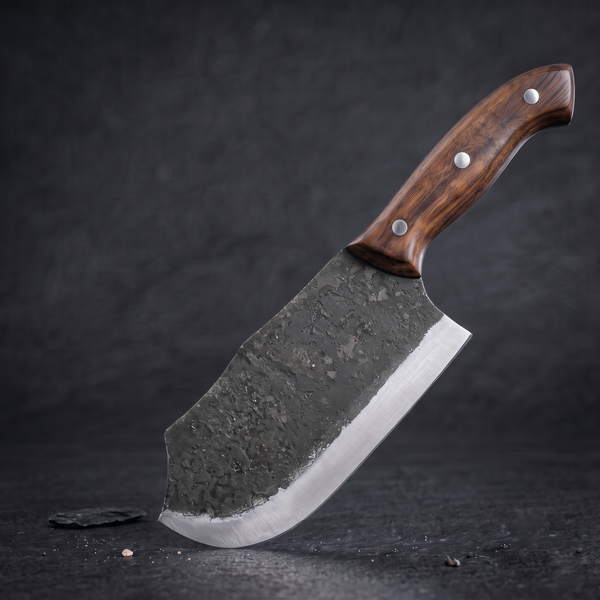
Every knife we make keeps forge scale or hammer texture on the flats, with only the edge ground bright. Forge scale is the dark grey skin steel takes on in the fire, as on the Mamba. Hammer texture is the dimpled surface the hammer leaves, as on the Kraken and Mastodon. Neither is a shape and neither makes the knife sharper. Both help slices release from the flat, and both save the maker from polishing, which a maker will tell you is a feature.
Which Blade Shape Is Best for a Kitchen?
If you own one knife, the tall curved chef cleaver is the hardest to argue with. It chops, it rocks, and it scoops what it just cut. If your cooking leans toward whole cuts and bone, add a tall rectangular cleaver, and pick the weight to match the jobs rather than the length. If you break down a lot of chicken, a trailing point boning knife earns its drawer space quickly. A drop point or spear point cleaver is the compromise for someone who wants one tall blade that can still find a joint. Nobody needs every shape, though plenty of people end up with all of them and seem happy about it.
If you want the Serbian style set against the Chinese style, our Serbian cleaver vs Chinese cleaver guide covers it. Every shape above is in our hand forged cleaver collection, all high carbon steel, full tang with steel pins, and covered by a lifetime warranty against defects in materials and craftsmanship. Pick the shape first. The length will sort itself out.
Questions
What is the difference between a drop point and a clip point knife?
On a drop point the spine curves gently down to a low tip backed by plenty of steel, so the point is sturdy and easy to steer. On a clip point a section of the spine is cut away near the front, leaving a finer, slightly upswept tip that gets into tight spots but has less steel behind it. The Kodiak is a drop point, the Mastodon a clip point.
What is a sheepsfoot blade good for?
A sheep foot blade has a straight edge and a spine that drops sharply to meet it, so there is almost no tip. That makes it a controlled slicing and dicing shape. You can rest fingers along the spine and push straight down with your weight behind the edge. Our 7 inch sheep foot cleaver comes in the Butcher's Trio and the Mastercraft set.
Does a finger hole change how a cleaver cuts?
No. A finger hole is a grip feature and a hanging hole, not a change to the blade shape. Hooking a finger through it locks the knife to your hand when you choke up on a tall blade, and it keeps a heavy cleaver from slipping in a wet grip. The Megalodon, Razorback and 5.5 inch clip point cleaver all have one.
Is a Serbian chef knife a cleaver or a chef knife?
It sits between the two. It has the height of a cleaver and the curved, rocking edge of a chef knife, which is why we call it a tall curved chef cleaver. Push straight down and it chops like a cleaver. Pivot on the front and it rocks like a chef knife. The Kermode 7 inch and the Chef's Kiss 7 inch are both this shape.
Which blade shape should I buy first for a home kitchen?
For one knife that does most jobs, a tall curved chef cleaver is the easiest choice, since it chops, rocks and scoops. If you cook a lot of whole cuts and bone, add a tall rectangular cleaver and choose the weight to suit the work. A trailing point boning knife is the next most useful shape if you break down poultry often.
Shop the knives from this guide
Keep reading
Types of Kitchen Knives and What Each One Is Actually For
A plain guide to the types of kitchen knives and their uses: chef knife, Serbian chef knife, meat cleaver, butcher knife, boning, fillet and...
Meat Cleaver Sizes Explained: Which Blade Length to Buy
Blade length is the number everyone shops by and the one that matters least. This guide explains what length, height, spine thickness and weight...
Why Do Cleavers Have a Hole in the Blade? What It Is Really For
The hole in a cleaver blade is a hanging hole first. On the Xcutlery Megalodon, Razorback and 5.5" clip point cleaver it is also...